ERP (Enterprise Resource Planning)software for manufacturers can make the difference between smooth production and costly chaos. Picture trying to meet deadlines when raw materials arrive late, inventory counts are wrong, and no one knows which orders are ready to ship. At the same time, your team is stuck updating spreadsheets and hunting for answers that should be easy to find.
ERP software replaces production chaos with streamlined operations. Instead of dealing with late materials, incorrect inventory counts, and uncertain shipping status, you gain clear visibility. Your team no longer wastes time updating spreadsheets or chasing data.
If this sounds familiar, you’re not alone.
This kind of operational chaos is expensive. Downtime alone consumes 8.3% of planned production time, and costs U.S. discrete manufacturers about $245 billion each year.
That’s why more manufacturers turn to ERP: to connect departments, cut delays, and build systems that scale with confidence.
In this guide, you’ll see the top ERP software for manufacturers and how to get real results by pairing it with IT support designed for the factory floor.
Key takeaways
- Use cloud ERP to cut IT overhead and gain real-time visibility across production, inventory, and supply chain workflows.
- Connect ERP with your manufacturing execution system to remove data silos and speed up production decisions.
- Focus on accurate material requirements planning to avoid shortages, reduce rework, and stay on schedule.
- Pick a software system that supports your full lifecycle, from quoting to fulfillment, not just finance.
- Partner with ERP-savvy MSPs to simplify setup, protect endpoints, and fine-tune the system for your plant.
Why ERP is mission-critical for modern manufacturers
Manufacturers need more than grit and skilled labor to succeed. You need systems that are built to support your speed, complexity, and scale. That’s where ERP software equips you with the tools to keep production efficient, decisions informed, and growth sustainable.
Instead of juggling spreadsheets, siloed tools, and outdated systems, an ERP system brings everything together: from raw materials to final delivery.
With modern ERP solutions, you can centralize:
- Inventory management and stock tracking
- Production scheduling and workflow planning
- Procurement and bill of materials visibility
- Financial management and reporting
- Quality control and compliance tracking
This integration provides real-time data, eliminates duplication, and enables smarter decisions across your operations.
Without an integrated ERP system, you’re likely facing:
- Production delays from inaccurate timelines or part shortages
- Manual errors in purchasing, invoicing, or accounting
- Siloed data that makes tracking performance and solving problems hard
- Poor visibility into customer demand and planning
For most growing manufacturers, ERP software is the fastest way to raise profits, cut rework, and future-proof operations. Whether you’re expanding, launching new product lines, or adapting to supply chain shifts, ERP gives you the foundation to scale without chaos.
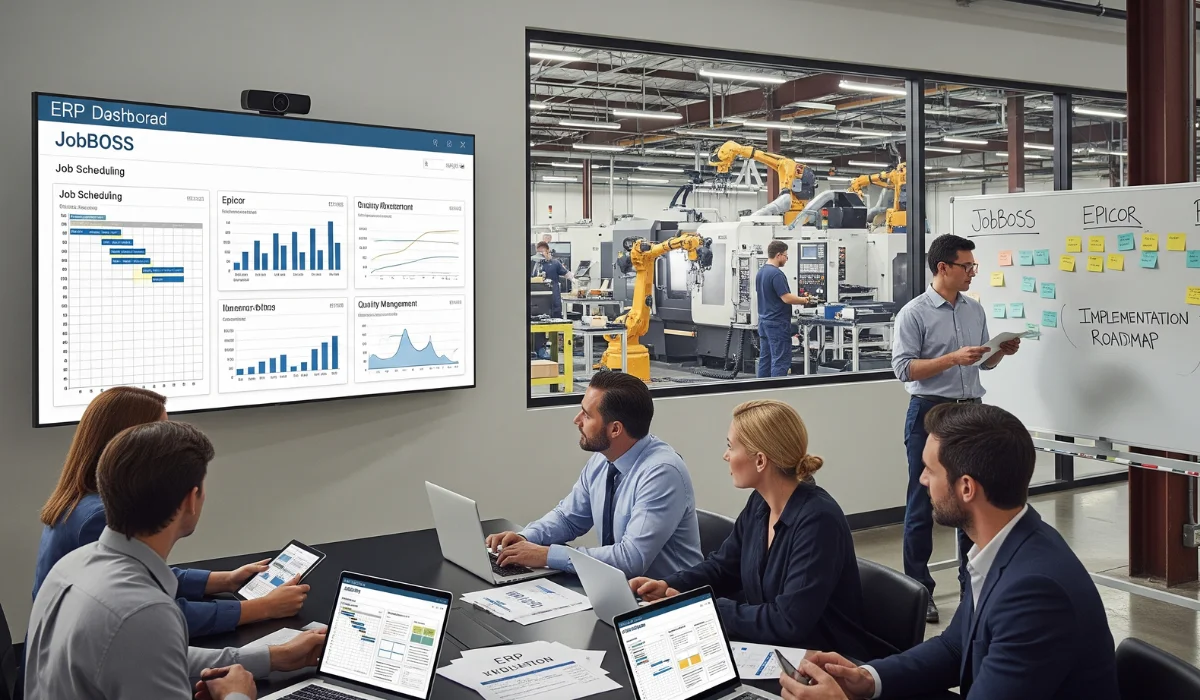
Top ERP software options for manufacturing
The right ERP depends on your business needs, workflows, and long-term goals. Below are proven platforms that deliver strong ROI for manufacturers.
| ERP Platform | Strengths | Best For |
|---|---|---|
| JobBOSS |
|
Small to midsize manufacturers with variable processes, low-volume/high-mix orders, or a high need for customer relationship traceability |
| Epicor |
|
Mid-market manufacturers need robust reporting, raw materials visibility, and detailed costing tools. Epicor Kinetic also supports advanced forecasting and automation |
| Plex |
|
Manufacturers focused on lean production, regulatory traceability, or continuous improvement, especially high-volume discrete manufacturing with complex compliance needs |
| Microsoft Dynamics GP / Great Plains |
|
Teams already using the Microsoft stack who need strong financials/general ledger functionality, and can supplement manufacturing via integrations or MSP support |
| QuickBooks + add-ons |
|
SMBs are not ready for full ERP but want better visibility/control. Useful as a stepping stone in a QuickBooks vs. ERP upgrade roadmap |
Platforms like SAP and NetSuite may also fit depending on your size and complexity, but they usually require longer timelines and higher costs. If you need faster wins and a realistic rollout, the systems above are often a better choice.
The most significant ERP pain points for manufacturers
Even the best ERP software for manufacturers can fail if it isn’t integrated, supported, and maintained correctly. It’s not enough to install the system; it must match how your factory runs. Too often, manufacturers face missteps that slow production and frustrate teams.
Here are five common ERP pain points:
- Weak internal IT support forces teams to troubleshoot or delay key updates
- Unplanned downtime, especially during rollouts or patching
- Fragmented tools like MES or inventory systems that don’t connect with ERP
- Unsecured networks and outdated software that leave ERP open to cyber threats
- Generic vendor support from teams that don’t understand manufacturing systems
According to CISA, ransomware threats in Operational Technology (OT) and Industrial Control Systems (ICS) environments call for strong segmentation, timely patching, and layered backups. Your ERP system is part of that ecosystem; if it’s not protected, it becomes a liability.
Solving these gaps starts by treating ERP as a long-term investment in your production, data, and decision-making; not as a one-time project.
Why manufacturers need an MSP that understands ERP
Once you identify ERP gaps, the next step is to find a partner to fill them. Most ERP vendors focus only on the software, not the IT environment, hardware, or shop floor devices. That’s why many manufacturers turn to a managed service provider (MSP) that understands how ERP systems work in real production settings.
An MSP bridges the gap between your ERP and the systems that run it.
How MSPs like Keystone support ERP infrastructure
Running ERP (enterprise resource planning) isn’t just about software; it’s about keeping every system secure, connected, and reliable. An experienced managed service provider (MSP) helps manufacturers:
- Manage your environment: Host and optimize Microsoft SQL or cloud ERP systems.
- Control access: Set up user accounts and permissions
- Build resilience: Use backup and disaster recovery strategies
- Connect tools: Integrate barcode scanners, IIoT sensors, and mobile devices on the shop floor
- Strengthen security: Apply cybersecurity best practices, including patching and segmentation
MSPs who know ERP for manufacturers also align systems like MES, Material Requirements Planning (MRP), CRM, and inventory tools. The ISA-95 standard shows how ERP (Level 4) should connect with MES (Level 3), and your MSP should help build that bridge.
With the right partner, you get:
- Smoother operations with fewer disruptions
- Real-time data flowing across all systems
- Lifecycle support for your critical tools
Whether you run a small business or a global plant network, an ERP-savvy MSP turns disconnected tools into unified solutions that work as hard as your team.
Real-world benefits of expert ERP support
Once ERP software is integrated with your operations, not just your accounting, you start seeing real results. ERP isn’t just about features; it’s about driving smarter decisions, cutting guesswork, and keeping production on track.
Here’s what expert ERP support unlocks:
- Less downtime across all key systems
- Faster quote-to-cash with integrated quoting, procurement, and fulfillment
- Better forecasting from real-time, consolidated data
- Stronger vendor reliability through clearer supply chain management
- Easier compliance with frameworks like CMMC, NIST, and ISA-95
In a NIST MEP case study, pairing ERP with barcode scanning improved replenishment speed and operational efficiency. That’s what happens when your ERP works with your workflows, not against them.
A well-supported ERP system also strengthens project management, simplifies documentation, and creates system-wide clarity. It helps you stay agile while planning around volatility, regulations, and shifting demand.
How Keystone helps manufacturers get the most from ERP
Your ERP is only as strong as its execution. When manufacturers manage ERP internally or rely on generalist IT providers, results often fall short. Keystone changes that.
We don’t just install ERP software. We ensure it performs under pressure, connects seamlessly with every system you rely on, and supports your workflows.
What Keystone delivers:
- Expertise in JobBOSS, Epicor, Plex, and Microsoft Dynamics GP
- Co-managed IT support to back your internal team without replacing it
- Proactive monitoring and patching to fix issues before disruptions
- Integration with MES, CRM, barcode scanners, and IoT devices
- Compliance-ready infrastructure for CMMC, NIST, and your needs
- Scalable support for both single-site and multi-location operations
Whether you’re moving from spreadsheets or expanding a complete ERP system, Keystone delivers lifecycle support that aligns technology, people, and process.
From webinars to on-site audits, from backups to access control, we help you streamline operations and extend the value of your ERP across every department. That’s not just support; that’s strategy.
Ready to maximize your ERP ROI?
Your ERP software should deliver more than just tracking; it should provide real-time clarity, enhance production planning, and integrate every stage of operations. When ERP runs smoothly, your shop floor follows.
The right support turns dashboards into action, cloud ERP into uptime, and data into decisions. You don’t need more complexity; you need a system that fits your workflows and grows with your business.
Book a free consultation today to see how Keystone helps manufacturers streamline ERP, secure operations, and stay production-ready.
FAQs
What are the most significant ERP software risks without IT support?
Without IT support, ERP software often leads to downtime, data loss, or failed integrations. Unpatched systems and flat networks raise ransomware risks. A co-managed IT provider adds backups, segmentation, and monitoring to keep production secure.
How do manufacturers choose the right ERP software?
Start by matching ERP software to your workflows, such as scheduling, inventory control, and traceability. Look for platforms with built-in MES or support for MES integration. Ask each vendor for a white paper with use cases in your sector.
What’s the best way to evaluate cloud ERP platforms?
Attend webinars and demo sessions focused on manufacturing use cases. Choose platforms that support IIoT, mobile access, and fast data sync. Ask about lifecycle support, rollout timelines, and compatibility with your current systems.