
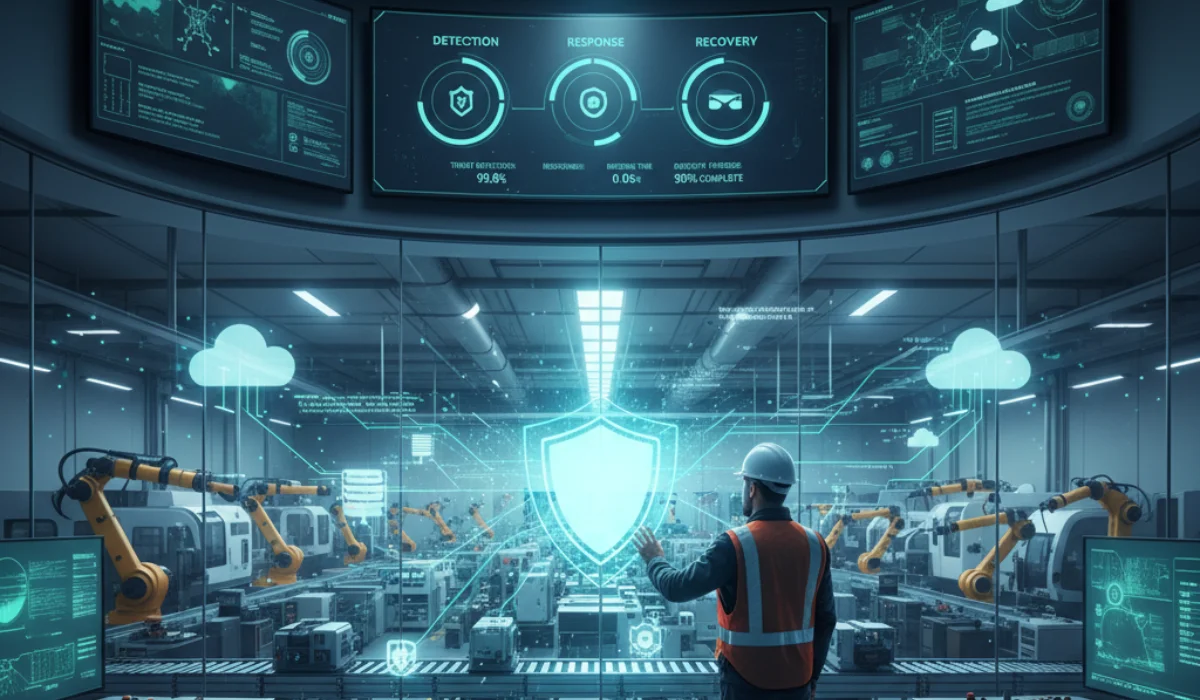
IBM reports that manufacturing remained the most frequently targeted industry for the fourth straight year, with ransomware leading the way. The company also found that the average cost of a U.S. data breach climbed to $10.22 million in 2025, the highest on record.
For manufacturers, that figure represents halted production lines, missed delivery contracts, and shaken customer confidence. Because every minute of downtime impacts revenue and safety, even a single breach can cause months of disruption and incur costly compliance risks.
Prevention-focused cybersecurity tools, such as firewalls, are no longer enough. True protection means building cyber resilience in manufacturing by detecting threats early, responding quickly, and recovering operations without losing productivity. Partnering with experts in co-managed IT for manufacturing growth and security can provide the visibility and collaboration needed to achieve this resilience.
In this article, we’ll explore how leading manufacturers build that resilience through detection, response, and recovery strategies, and how Keystone’s cyber resilience assessment can help you apply the same approach to keep your systems running when others go dark.
Key takeaways
- Build resilience, not just defenses, to keep your operations online and minimize costly downtime during cyber incidents.
- Test incident response and recovery plans regularly to shorten outages and protect production schedules.
- Align IT and OT teams under a single resilience framework to reduce risk and enhance communication during crises.
- Train employees and vendors to recognize threats quickly and follow response steps confidently.
- Commit to continuous improvement by reviewing each incident and updating detection and recovery processes.
What cyber resilience means for manufacturers
Cyber resilience and cybersecurity are closely related but fundamentally different. Cybersecurity focuses on prevention, keeping attackers out. Cyber resilience assumes they will get in and prepares your organization to operate safely even when systems are compromised. For the manufacturing industry, that means planning not only for prevention but also for continuity, detection, response, and recovery.
Your operational technology (OT) and information technology (IT) environments are now deeply connected. As IoT is transforming the manufacturing industry, machine sensors, industrial control systems, and cloud dashboards increasingly share data across networks.
Legacy systems often run unsupported software, creating openings for attackers and complicating patching cycles. Investing in IT modernization in manufacturing closes these gaps and improves resilience across connected systems. A single malfunction, such as a programmable logic controller (PLC) freezing during a patch window, can stall production across an entire facility.
According to Uptime Institute, 54% of major outages cost over $100,000, and nearly 20% exceed $1 million.
The NIST Cybersecurity Framework (CSF) 2.0 formalizes this shift from prevention to resilience, outlining six functions every manufacturer should address:
- Govern – Establish accountability and oversight.
- Identify – Understand assets, risks, and interdependencies. A structured manufacturing risk assessment clarifies where vulnerabilities exist before they become operational threats.
- Protect – Apply safeguards to limit impact.
- Detect – Monitor anomalies in real time.
- Respond – Contain and mitigate incidents quickly.
- Recover – Restore operations and learn from events.
Together, these functions create a continuous loop of improvement that strengthens operations across the manufacturing sector. These vulnerabilities explain why traditional firewalls alone fall short in maintaining operational resilience.
Firewalls alone don’t protect manufacturers
Traditional firewalls block known external threats but can’t stop attacks that move through trusted connections or misconfigured accounts. Modern cyberattacks often enter through familiar doors, including remote access portals, vendor networks, or poorly secured applications, and then pivot into operational environments.
Consider this scenario: a trusted maintenance vendor connects through an outdated VPN to perform diagnostics on a robotic system. The credentials have been reused across multiple clients. Within minutes, ransomware spreads from the vendor session to engineering workstations, halting production across several manufacturing companies in the same supply chain.
Dragos reports that most industrial ransomware entries originate from public applications or VPNs that pivot into OT environments, with manufacturing accounting for the majority of victims. Applying strong risk management in the supply chain practices can reduce exposure from vendor and partner networks.
This trend aligns with Verizon’s 2025 Data Breach Investigations Report, which highlights a high concentration of risk across NAICS codes 31–33, the core manufacturing sector where vendors and integrators maintain constant remote access.
Firewalls are essential but insufficient. Without multi-factor authentication, vendor oversight, and continuous monitoring, they can’t stop lateral movement that cripples production. Next, we’ll explore how manufacturers detect and respond before damage escalates.
Core pillars of cyber resilience in manufacturing
The foundation of cyber resilience in manufacturing rests on four interconnected pillars: Detect, Respond, Recover, and Adapt. When each pillar functions as part of a unified strategy, manufacturers reduce downtime, protect assets, and maintain customer trust. Downtime costs are rising, and resilience reduces those losses by helping your organization recover faster and avoid repeat disruptions.
Detect threats before they spread
Early detection is the key to preventing a contained incident from escalating into a production-wide shutdown. Manufacturers use Security Information and Event Management (SIEM) platforms and real-time anomaly detection tools across IT and OT environments to identify suspicious activity before it causes damage. These tools analyze traffic from IoT devices, sensors, and controllers to spot irregular commands or logins that may indicate a breach through remote access.
For example, a robotic arm suddenly receives a command sequence that deviates from its regular pattern. Automated detection triggers an immediate shutdown, isolating the threat and preventing it from having a broader impact. This type of system-wide connectivity enables faster response, giving manufacturers valuable time to stop attackers before they move deeper into the network.
Respond with a tested incident plan
A well-practiced response plan limits confusion and loss during a cyber event. Manufacturers should document roles, contacts, and response timelines in advance to ensure that teams are aware of who leads containment, communication, and recovery efforts. Regular simulations validate readiness and reveal process gaps.
IBM’s 2025 Cost of a Data Breach Report found that companies leveraging security AI and automation reduced breach costs by an average of $1.9 million, primarily due to faster response times.
Response initiatives are most effective when supported by leadership buy-in, cross-departmental coordination, and regular review of threat data. Implementing co-managed IT for manufacturing enhances collaboration across departments, thereby strengthening overall cyber resilience. When everyone understands their role, recovery can begin within hours instead of days.
Recover operations quickly and safely
Resilient manufacturers test their recovery systems quarterly to verify backup integrity and ensure a fast failover. Immutable backups, which cannot be altered or deleted, protect against ransomware encryption. Recovery teams should also maintain golden images for critical systems, such as human-machine interfaces (HMIs) and engineering workstations, to ensure seamless recovery. Preventing production downtime through proactive IT support reduces restoration time and ensures manufacturing lines run smoothly.
Research shows outage costs are rising even as frequency dips, making rapid restoration the most effective cost-control lever.
These tests ensure your organization can restore full operations quickly and safely, reducing downtime and financial exposure while preserving plant-floor safety.
Adapt through post-incident learning
Cyber resilience is not static; it evolves with every incident that occurs. After an event, conduct root-cause reviews to identify what went wrong and adjust access policies, vendor permissions, and detection rules. Each improvement reduces the likelihood of recurrence and strengthens your defensive posture.
NIST emphasizes continuous improvement across Detect, Respond, and Recover functions, urging manufacturers to embed feedback loops into their cyber programs.
By turning lessons into action, you build resilience that keeps pace with new threats and operational realities.
Building a detection-to-recovery framework
A functional detection-to-recovery framework bridges the gap between IT and OT, ensuring data and control systems support one another without creating new vulnerabilities. Start by mapping how systems communicate, what connects to what, and where those connections expose potential cyber threats.
Apply zero-trust principles to verify every access attempt, enforce network segmentation to limit lateral movement, and require multi-factor authentication for all privileged accounts. Strong cybersecurity practices reduce both exposure and human error, especially in environments where phishing and credential misuse remain top risks.
Automation should drive alerts, failovers, and recovery actions. Automation should drive alerts, failovers, and recovery actions. Many smart factories use MSPs to streamline production and automate recovery workflows to maintain uptime. For example, a gold-image rebuild for HMIs and engineering workstations can restore production within hours rather than days.
Fast restore capability is the single strongest lever for cutting outage costs. A strong framework transforms reactive response into proactive resilience, lowering cybersecurity risks across both business and plant operations.
Foster a culture of cyber resilience
Technology alone cannot build resilience; it requires people, process, and shared responsibility. To truly strengthen protection, manufacturers must align stakeholders across engineering, IT, and executive leadership. When these teams collaborate, they transform cybersecurity from a reactive function into a unified operational priority that protects uptime and customer trust.
Building that culture means integrating risk assessment, vendor training, and ongoing awareness campaigns into everyday routines. The goal is to make resilience second nature for everyone who touches the network.
By fostering a sustainable ecosystem of partners and informed employees, you position your organization to identify, contain, and recover from threats faster than they can disrupt production.
How Keystone helps manufacturers strengthen cyber Resilience
Keystone helps manufacturers turn preparation into measurable protection. Our services include continuous monitoring across IT, OT, and ERP systems, alignment with NIST and ISO 27001 frameworks, and customized employee training to build awareness from the plant floor to the boardroom.
Our team helps manufacturers reduce downtime and minimize risk by closing gaps before attackers can exploit them. We design resilience programs tailored to your specific environment, reinforce compliance standards, and empower your teams to remain confident in their ability to respond effectively.
With Keystone, you gain a partner dedicated to long-term resilience, not just short-term defense.
Final thoughts: from firewalls to full resilience
We help manufacturing leaders identify and address detection-to-recovery gaps, thereby accelerating response times. Learn more about building cyber resilience in manufacturing and how Keystone strengthens detection, response, and recovery readiness.
Our cyber resilience assessment identifies where your systems are strong, where they’re exposed, and what actions will make them more secure.
Ready to reduce downtime and strengthen your resilience? Contact Keystone today to schedule your assessment.
FAQs
What is cyber resilience in manufacturing, and how is it different from traditional cybersecurity?
Cyber resilience enables manufacturers to maintain uninterrupted production even during an attack. Traditional cybersecurity focuses on blocking threats, while resilience prepares IT and OT environments to detect, respond to, and recover from incidents quickly, thereby reducing downtime and costs.
How can manufacturers reduce downtime after a ransomware attack?
The best way to limit downtime is to maintain immutable, offline backups and regularly test recovery plans. Manufacturers should conduct restoration drills and partner with security experts who can quickly restore OT systems while protecting production data.
What best practices strengthen cyber resilience in manufacturing networks?
Strong cyber resilience starts with zero-trust access, multi-factor authentication, and continuous monitoring of IT and OT networks. Regular updates, staff training, and segmented networks help stop attacks early and keep production running safely.