Seventy percent of manufacturers still collect at least some production data manually, according to the Manufacturing Leadership Council. This shows how far many plants are from being ready for Industry 4.0.
If you’re a CIO or operations leader, that statistic highlights a significant risk: delayed visibility, avoidable errors, and unplanned downtime. IT is the key to closing that gap. With smart manufacturing analytics, you can capture and analyze real-time data across machines, materials, and teams, thereby enabling faster and more accurate decision-making.
This article explains why analytics is critical for efficiency and quality, the IT backbone that supports Industry 4.0, and proven use cases that deliver ROI. It also covers how to overcome barriers such as legacy systems, cybersecurity risks, and skills gaps, and demonstrates how Keystone helps manufacturers turn data into actionable insights that keep them competitive.
Key takeaways
- Reduce downtime with predictive analytics that flag inefficiencies before they halt production. Enhance throughput by leveraging artificial intelligence and robotics to optimize processes.
- Unify data across manufacturing systems to improve visibility and prevent scheduling conflicts.
- Optimize operations with cloud-based analytics platforms that track critical metrics for profit and compliance.
- Improve quality by applying targeted technologies that cut waste and deliver measurable ROI.
Why Analytics Is Critical in Manufacturing
Real-time data keeps production balanced, improves quality control, reduces downtime, and enables faster decision-making across the supply chain.
Driving real-time decision-making
Every minute without visibility costs money. When your production data updates in real time, you can rebalance workloads, reroute jobs, and prevent minor issues from snowballing into expensive stoppages.
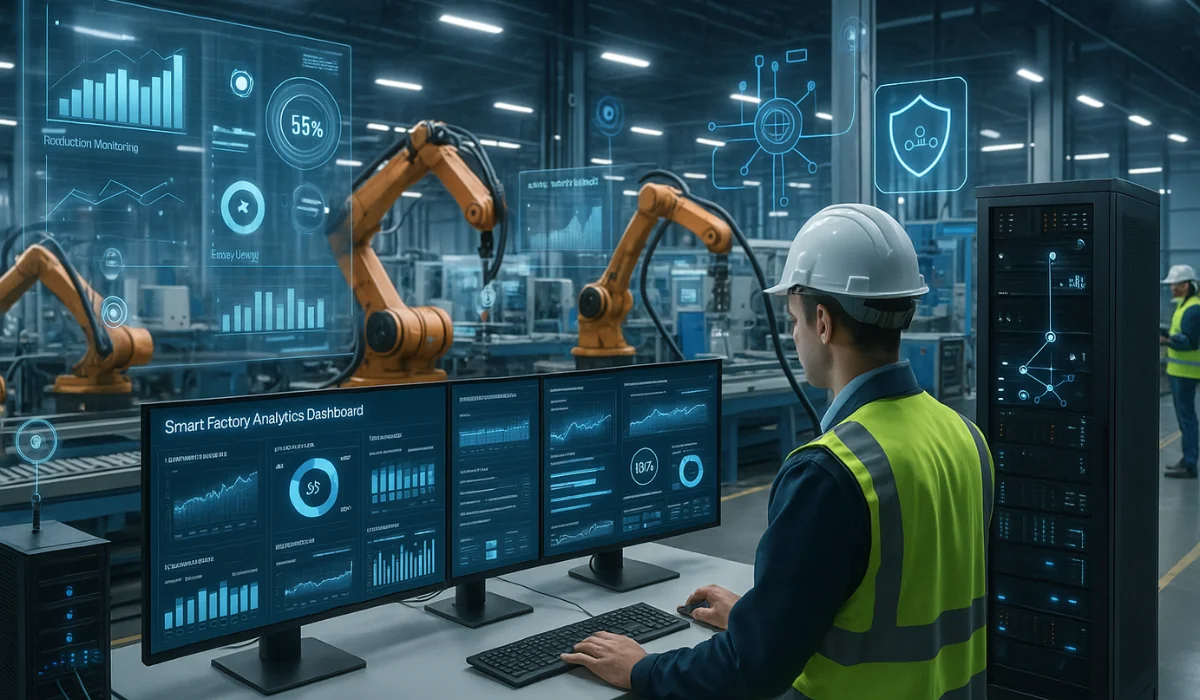
Dashboards that integrate ERP software orders with MES performance create a single source of truth, a gap most CIOs still cite. Research shows that companies acting on real-time insights see 62% higher revenue and 97% higher profit margins. In other words, speed isn’t just operational; it’s financial.
Reducing downtime with predictive maintenance
Few things erode margins faster than unplanned downtime during a high-volume run.
Traditional maintenance is reactive, often leaving teams scrambling for parts and technicians. Predictive maintenance monitors vibration, temperature, and current draw to identify wear before it leads to breakdowns. This allows you to stage parts, schedule service during off-shifts, and avoid production chaos.
Deloitte reports poor maintenance practices can cut productive capacity by up to 20%, so even small gains in uptime translate to significant revenue protection.
Improving quality and supply chain visibility
Quality issues ripple across the supply chain, delaying shipments and risking customer trust. Automating quality control data and feeding it back into suppliers and production systems creates a loop that improves with every cycle.
Research shows that integrating data analytics has become a key driver of informed decision-making, demonstrating that connected analytics not only improves product quality but also strengthens supplier performance and boosts on-time delivery.
The IT Backbone of Manufacturing Analytics
Without a connected IT foundation, data remains siloed; however, ERP–MES integration, IoT sensors, and cloud-based platforms create the resilient infrastructure that Industry 4.0 demands.
Connecting ERP and MES for visibility
Disconnected systems create blind spots. By integrating ERP and MES, you gain synchronized production orders, real-time WIP tracking, and accurate material consumption data. This improves schedule adherence and inventory management, reducing the need for firefighting and expensive expedite fees.
Plants with ERP–MES integration improve schedule adherence by 10–15%, unlocking capacity and cutting costly expedite fees.
Deploying IoT sensors and digital twins
On today’s shop floor, data-rich assets are your competitive edge. IoT and IIoT sensors stream live signals on equipment health, while digital twins let you run what-if scenarios and stress-test production plans before making costly changes.
According to McKinsey, 86% of manufacturing executives believe digital twins apply to their operations, and nearly half have already implemented them.
Leveraging cloud-based analytics platforms
Modern analytics demand compute power beyond a single plant’s servers. Cloud-based platforms let you aggregate volumes of data, run machine learning algorithms, and share dashboards securely across global teams.
At the facility or network level, 57% of manufacturers are already using cloud computing and data analytics, with nearly 90% planning to sustain or grow that investment next year. With this backbone, IT leaders can support enterprise-wide initiatives while meeting cybersecurity and compliance requirements.
Use Cases of Smart Manufacturing Analytics
Intelligent manufacturing analytics turns raw plant data into a competitive advantage, cutting costs, reducing risk, and driving measurable ROI across your operations.
Predictive maintenance in action
Prioritize high-value assets where a failure would halt production. Stream real-time data from vibration, temperature, and current draw into machine learning algorithms that flag early signs of wear.
According to PwC, AI-enabled predictive maintenance could reduce maintenance costs by up to 30% and unplanned downtime by 45%.
Optimizing energy use
Energy waste quietly erodes margins. By tying energy meters to MES events and calculating energy per unit produced, you can identify inefficient workflows and reschedule high-load operations during off-peak hours.
According to the U.S. Department of Energy, total electricity use in data centers has tripled since 2014. It could nearly triple again by 2028, underscoring the financial and environmental impact of unchecked energy consumption. These insights also help you meet sustainability targets and qualify for incentive programs, creating a double payoff.
Forecasting demand and capacity
Machine learning models can detect demand shifts earlier than traditional methods, enabling you to optimize inventory levels and staffing more effectively. This maintains steady throughput even during market volatility.
A recent survey found that 78% of manufacturers plan to increase spending on AI tools over the next two years, indicating that advanced forecasting has become a core growth strategy, rather than a luxury.
Overcoming Barriers to Analytics Adoption
Analytics can unlock significant gains, but adoption often stalls when operational realities get in the way. Addressing these barriers early sets the stage for measurable ROI and supports long-term digital transformation initiatives.
Ensuring legacy system compatibility
Many plants rely on PLCs, HMIs, and MES platforms that were never built for modern IT/OT integration. Instead of a disruptive rip-and-replace effort, leaders can:
- Wrap legacy assets with adapters to capture data without halting production.
- Normalize tag structures to create consistent data models across lines and sites.
- Build a governed data layer to prepare manufacturing systems for future technologies, such as predictive analytics and digital twins (virtual models that enable testing scenarios without risking downtime).
This phased approach minimizes disruption while laying the foundation for better decision-making.
Securing data pipelines
More connectivity means a larger attack surface. Security leaders should:
- Segment networks to isolate critical operations from enterprise IT.
- Apply role-based access controls to limit who can view or modify data.
- Monitor data flows continuously to spot anomalies before they escalate.
Pairing these measures with clear data governance policies ensures analytics outputs remain trusted, auditable, and compliant, key concerns for boards and regulators.
Closing analytics skills gaps
Technology adoption fails without a skilled workforce. Executives can:
- Upskill teams in data analysis so frontline employees can use insights confidently.
- Standardize key metrics through shared glossaries that align departments.
- Appoint data stewards to maintain data quality and resolve issues quickly.
This reduces wasted effort, accelerates time-to-insight, and creates a culture of continuous improvement that aligns with strategic goals.
When you address integration, security, and skills gaps in parallel, you not only enable analytics; you protect revenue, safeguard uptime, and make your organization more resilient to market shocks.
How Keystone Helps Manufacturers Harness Analytics
Keystone helps you move from firefighting to foresight, turning fragmented plant data into a single source of truth that drives measurable ROI.
Building secure data integration layers
We unify ERP, MES, historian, and IoT sensor data into a governed analytics layer. This eliminates manual entry, closes reporting gaps, and gives your operations and IT teams a trusted, shared view of throughput, quality, and energy consumption.
Supporting cloud and hybrid architectures
Keystone designs solutions that balance edge control with cloud-based scalability, allowing you to run analytics and machine learning algorithms at an enterprise scale without compromising plant reliability. This architecture keeps your compliance, cybersecurity, and uptime requirements intact while enabling enterprise-wide decision-making.
Data-Driven Factories Are the Future
Analytics is the foundation of Industry 4.0 and the answer to the very challenges that keep you up at night: downtime, quality escapes, and rising energy costs. When you connect your data, you get faster decisions, steadier schedules, and healthier margins. Manufacturers that act on real-time data now will stay ahead, while those that wait risk falling behind after the next disruption.
Schedule a Keystone manufacturing analytics consultation today to turn hidden plant data into measurable growth.
FAQs
How is big data changing the manufacturing industry?
Big data enables manufacturing to shift from reactive to proactive operations by uncovering production patterns. With advanced analytics and real-time data collection, companies can predict failures, optimize manufacturing processes, and cut costs. The result is measurable ROI and continuous improvement.
Why is cloud computing essential for digital transformation in manufacturing?
Cloud computing provides scalable storage and enables faster data analysis, facilitating seamless connections between systems across multiple sites. It creates a single source of truth for decision-making, accelerates innovation, and improves connectivity. Reducing capital investment enables businesses to adopt new manufacturing technologies and accelerate digital transformation.
How can manufacturers use data to drive continuous improvement?
Manufacturers in sectors such as automotive, aerospace, and electronics utilize big data and advanced analytics to track key metrics, identify inefficiencies, and enhance throughput. Applying these insights supports continuous improvement programs, optimizes manufacturing environments, and builds more resilient operations across the supply chain.