
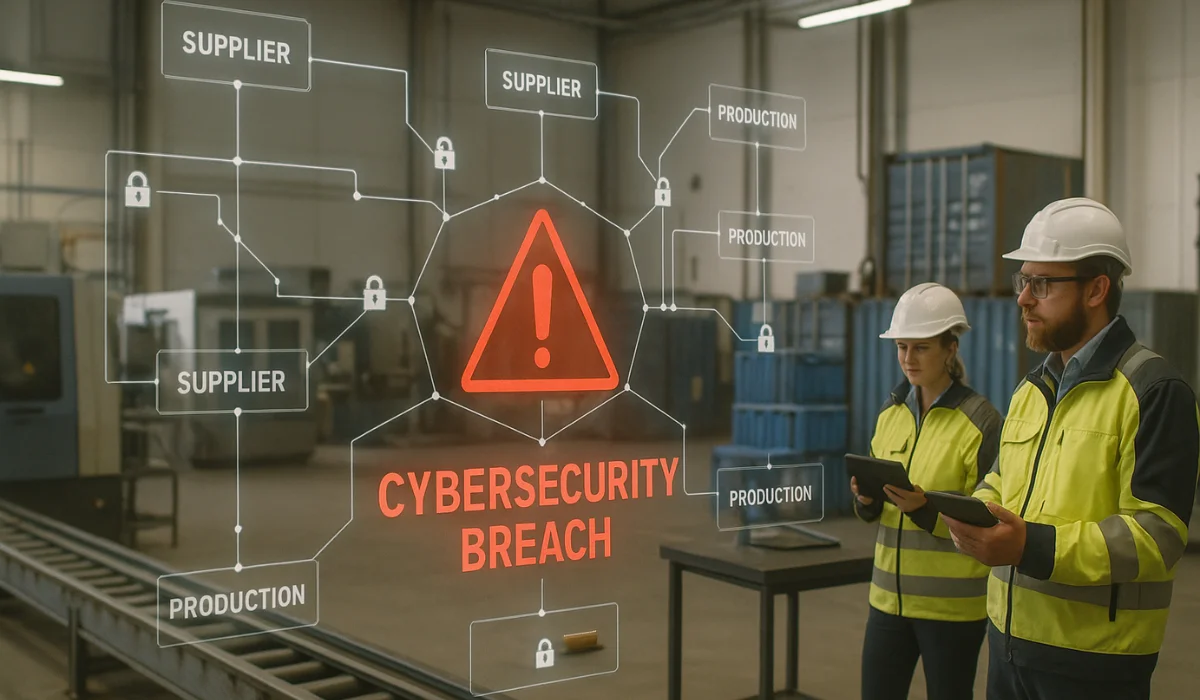
Supply chain attacks are now the fastest-growing threat to the manufacturing industry. Third-party involvement in breaches has doubled to 30%. Ransomware appears in 44% of cases.
For you, that means every vendor, logistics partner, and connected system could be a point of entry for attackers. Modern manufacturing depends on digital collaboration, but every integration expands your attack surface. A single weak supplier can expose sensitive data, shut down production, and create costly compliance issues under NIST or CMMC standards.
That’s why supply chain cybersecurity in manufacturing, along with trusted partners like Keystone’s cybersecurity team, is essential for protecting uptime and preserving customer trust.
In this article, you will learn how supply chain attacks unfold, what they cost manufacturers, and how to build a defense that keeps your vendor network secure and your production lines moving.
Key takeaways
- Map vendor relationships to identify and prioritize high-risk connections before attackers do.
- Treat supplier access as a privilege that requires continuous verification, not blind trust.
- Integrate cybersecurity checks into procurement to reduce risk before contracts are signed.
- Monitor vendor activity and rehearse response plans to contain incidents quickly.
- Partner with Keystone to enhance visibility, maintain compliance, and ensure secure production.
Understand the hidden complexity of modern manufacturing supply chains
Modern manufacturing runs on constantly evolving digital systems. Your Enterprise Resource Planning (ERP) and Manufacturing Execution Systems (MES) connect production, suppliers, and logistics partners across global networks. Each integration adds efficiency, but also increases your supply chain dependencies and widens the attack surface.
Automation and IoT are transforming the manufacturing industry, feeding real-time data between Operational Technology (OT) environments and enterprise networks. This connectivity improves oversight but introduces vulnerabilities that attackers can exploit. Legacy machinery built decades ago often lacks encryption or access controls, creating unguarded entry points for cybercriminals. Upgrading through IT modernization in manufacturing helps close these gaps and improve operational resilience.
The MOVEit 2024 file-transfer breach demonstrated how a single software vulnerability can spread across manufacturing organizations, disrupting operations and exposing data through shared vendor systems. Ransomware complaints against U.S. critical infrastructure, including manufacturing, increased by 9% in 2024, with total losses reaching $16.6 billion. This underscores the urgent need for proactive vendor monitoring and network segmentation, a reminder that network monitoring is critical for manufacturing operations to detect threats before they spread.
How supply chain cyberattacks happen
Cybercriminals often infiltrate manufacturing networks through trusted partners, rather than launching direct attacks.
A compromised software update, like the SolarWinds breach, can insert malicious code into production systems disguised as legitimate maintenance. Many smart factories use MSPs to streamline production and manage secure updates to prevent such attacks. Stolen credentials from a third-party vendor can grant unauthorized access to sensitive controls or data. Phishing campaigns and fake Requests for Quote (RFQs) frequently target procurement staff to capture login details and payment information.
Once inside, attackers can manipulate logistics data, delay shipments, or corrupt inventory records, creating costly downtime and confusion across your production lines. Each tactic turns supplier trust into operational risk, underscoring the importance of vendor oversight and incident response planning as integral components of your core cybersecurity strategy. Learn more about risk management in the supply chain to better identify and mitigate third-party exposure.
The real-world impact of supply chain breaches
Every connection in your supply chain carries both opportunity and risk. When a vendor or logistics partner experiences a breach, the ripple effects can reach your factory floor in hours, not days.
Understanding these consequences helps you measure your actual supply chain risk and prioritize mitigation before production halts.
Reduce downtime and production halts from vendor failures
When a key supplier’s systems go offline, production schedules collapse and delivery deadlines vanish. Unsecured vendor portals or software outages can cascade through the manufacturing sector, freezing operations and draining revenue. Preventing production downtime through proactive IT support enables manufacturers to identify and resolve potential issues before they disrupt operations.
Proactive incident planning and vendor redundancy help prevent downtime from escalating into a disaster.
Prevent data breaches and loss of intellectual property
Third-party systems often handle sensitive data such as product designs, formulas, and pricing models. Once leaked, that intellectual property can’t be reclaimed. Encrypt data exchanges and limit external access to protect proprietary assets from theft or tampering.
Protect brand trust from supplier breach fallout
Your reputation travels the same path as your materials. When an unvetted vendor exposes customer data, headlines tie the breach to your name, not theirs. Vendor monitoring and clear response protocols protect customer trust and long-term contracts.
Meet evolving compliance standards (NIST, CMMC, ISO)
Regulators continue to tighten cybersecurity expectations for manufacturers handling controlled data. NIST SP 800-161 (C-SCRM) and NIST SP 800-171 Rev. 3 raise requirements for protecting Controlled Unclassified Information (CUI).
Meeting these standards strengthens audit readiness and reduces liability across critical infrastructure and customer data pipelines.
Every breach reinforces a single truth: prevention is always cheaper than recovery. To transition from a reactive to a resilient approach, manufacturers must adopt a structured framework that integrates cybersecurity into every stage of vendor management.
Strengthen supply chain cybersecurity with a practical framework
A secure supply chain depends on structured, repeatable processes, not one-time audits. By embedding precise controls and continuous monitoring into vendor management, you can reduce risk exposure across your entire manufacturing lifecycle.
Conduct third-party risk assessments before onboarding
Evaluate each new supplier’s security posture before signing contracts. Verify how they store, transmit, and protect your data. This step prevents vulnerabilities from entering your ecosystem at the start.
Limit vendor access rights and monitor activity
Vendors should only have the access necessary to perform their function. Apply authentication controls and regularly review permissions. Real-time monitoring reveals unusual logins or file movements before they escalate into breaches.
Require recognized cybersecurity certifications (ISO 27001, CMMC)
Use certification as proof of accountability. The CMMC Final Rule begins a three-year rollout requiring Department of Defense contractors to undergo phased third-party verification starting November 10, 2025.
For non-defense suppliers, ISO 27001 remains a benchmark for information security maturity.
Automate continuous vendor monitoring and threat intelligence
Automated tools track external vulnerabilities and threat intelligence feeds tied to your suppliers. These tools alert your team to new exploits affecting shared software or hardware, allowing faster mitigation and reducing manual workload.
Include incident response plans in supplier contracts
Contracts should clearly define notification timelines, escalation procedures, and coordination steps in the event of a breach. Clear expectations ensure that vendors respond promptly and consistently when incidents occur, thereby preserving both production continuity and brand credibility.
Together, these measures form a proactive risk management framework that supports compliance, strengthens supply chain security measures, and sustains operational resilience across your extended manufacturing network, which are core goals of building cyber resilience in manufacturing.
Watch emerging supply chain threats heading into 2026
Cybercriminals are evolving as quickly as the technology that powers modern manufacturing. Artificial intelligence, deepfakes, and interconnected devices are reshaping the threat landscape, creating new vulnerabilities across procurement, logistics, and operations. Staying ahead means knowing what’s next and adapting your defenses before attackers exploit these tools.
Defend against AI-generated phishing targeting procurement
Attackers now use AI to generate convincing phishing emails that mimic the tone, invoice format, and product details of your vendors. These messages often slip past traditional filters and land directly in the inboxes of procurement staff or finance teams. Reports indicate that weaponized AI and social engineering attacks are on the rise across critical industries.
Training employees to recognize subtle anomalies, verifying payment requests through secondary channels, and utilizing AI-based detection tools can prevent these threats from triggering a costly transfer or compromising vendor credentials.
Detect deepfake impersonation of supplier executives
Sophisticated threat actors are now using synthetic voice and video to impersonate executives or suppliers during urgent calls and virtual meetings. These deepfakes often pressure employees to release shipments, change bank details, or share credentials.
Deploying verification protocols such as secure call-back procedures and multifactor authentication for financial approvals helps neutralize deception before it disrupts supply chain operations.
Secure IoT and automation in smart logistics systems
Automation and smart sensors have revolutionized inventory tracking and logistics, but they also create a vast network of potential entry points for unauthorized access. Many Internet of Things (IoT) devices ship with weak credentials or unpatched firmware, exposing operational systems to ransomware attacks or malware infections. Regularly updating firmware, segmenting IoT networks, and monitoring device behavior are key to preventing cybercrime from spreading through connected equipment.
These emerging threats demonstrate that 2026 cybersecurity demands the same precision and foresight that manufacturers apply to their production processes. Integrating real-time threat intelligence and proactive monitoring across every connected function will be essential to maintaining both uptime and trust.
How Keystone protects manufacturing supply chains
Protecting a manufacturing supply chain demands visibility, speed, and coordination. Keystone combines managed IT expertise with proactive cybersecurity to safeguard every layer of your vendor ecosystem, from ERP systems to plant-floor endpoints. Through co-managed IT for manufacturing, companies gain shared visibility and faster response coordination.
Keystone’s vendor risk management program integrates directly with your procurement and IT processes, an approach that mirrors how IT integrations strengthen manufacturing supply chains, ensuring suppliers meet security requirements before they connect to your network.
Round-the-clock monitoring detects anomalies and isolates compromised endpoints before cyber threats can spread between plants or partners. Coordinated incident response aligns IT, operations, and vendor teams to quickly contain and remediate issues, minimizing downtime and financial impact.
As CISA Director Jen Easterly states: “Cybersecurity is not an impossible problem; the solution lies in secure by design.”
That philosophy defines Keystone’s approach: integrating risk management, continuous oversight, and secure-by-design practices to build stronger, more resilient manufacturing networks that can withstand the next wave of supply chain threats.
Final thoughts: secure your entire supply chain
Your supply chain cybersecurity is only as strong as your weakest supplier.
In today’s connected manufacturing ecosystem, one unsecured vendor or outdated integration can expose every partner in the chain. Protecting your organization means protecting the entire network that keeps production moving.
Manufacturing leaders, IT teams, and operations staff should treat vendor oversight as a shared responsibility. Extending defenses beyond your walls, to include contractors, logistics partners, and cloud providers, creates resilience that technology alone cannot guarantee.
Every connection, from Operational Technology (OT) environments to Industrial Control Systems (ICS), should follow the same standards of visibility, control, and continuous monitoring.
Keystone’s unified approach helps manufacturers turn compliance into confidence, building a stronger foundation for long-term resilience and operational trust.
Let’s map your vendor risk and harden your supply chain. Talk to Keystone today.
FAQs
How can manufacturers improve OT security without disrupting production?
Segment OT systems from business networks to reduce risk. Use access controls, monitor traffic, and keep device firmware up to date. Partnering with an OT cybersecurity expert helps apply updates and monitoring without interrupting production.
What are the first steps to strengthen supply chain cybersecurity in manufacturing?
Begin with a comprehensive vendor risk assessment to identify potential weak links. Set clear OT security and data protection requirements for suppliers. Include response steps in contracts and utilize continuous monitoring to promptly detect and mitigate third-party risks.
How does a managed IT partner help secure OT environments from cyber threats?
A managed security partner provides 24/7 monitoring, threat alerts, and rapid response designed for OT networks. They secure industrial control systems, ERP platforms, and vendor links to reduce downtime, maintain compliance, and keep manufacturing systems ready for new cyber threats.