
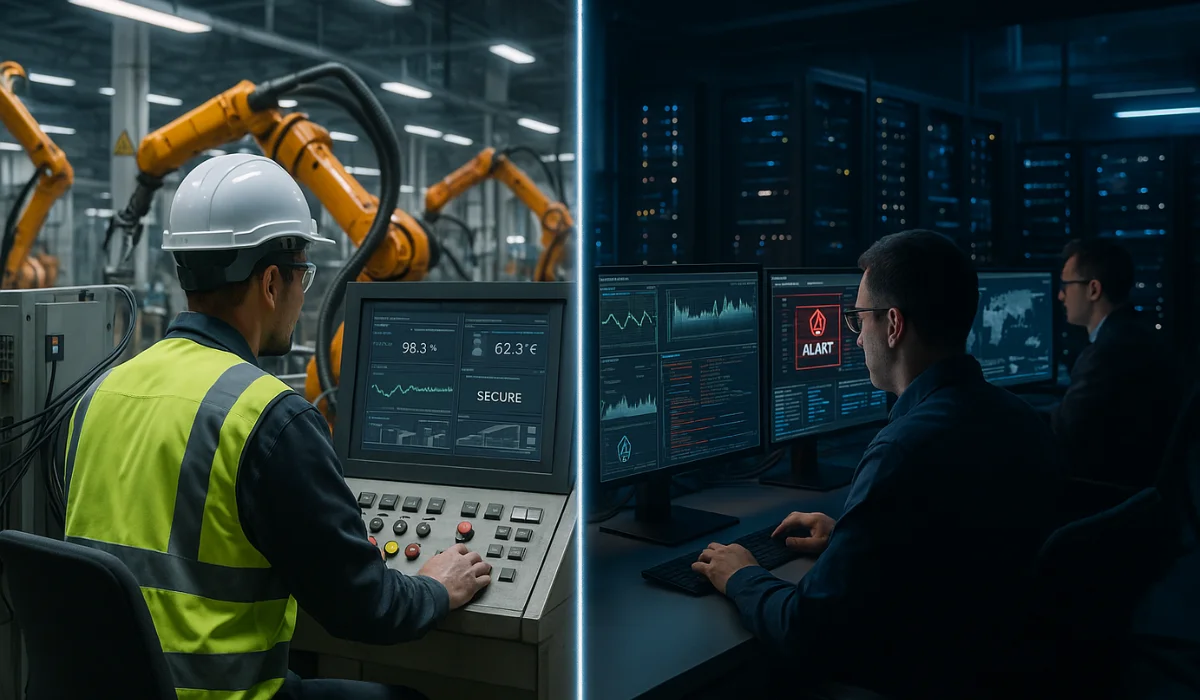
In a growing wave of sophisticated cyber threats targeting the industrial sector, ransomware attacks increased by 46% from Q4 2024 to Q1 2025, according to Honeywell’s 2025 Cybersecurity Threat Report.
For manufacturers running PLCs, SCADA, or other control systems, this is a warning. Standard IT defenses often miss the unique vulnerabilities of operational technology, leaving you open to breaches, downtime, and compliance exposure.
This article explains the differences between ICS security for manufacturing and traditional IT security, why IT defenses often fall short in factories, and how frameworks like NIST CSF and IEC 62443 help close the gaps.
You’ll learn about the most pressing ICS threats, practical steps to strengthen OT networks, and why specialized security is essential for maintaining uptime and meeting audit requirements. By the end, you’ll see why scheduling an ICS security assessment is a smart next step.
Key takeaways
- Automate threat detection and strengthen networks to prevent attacks from causing downtime or compliance failures.
- Apply layered security measures aligned with IEC 62443 to protect industrial processes and streamline audits.
- Deploy secure OT–IT connections that improve connectivity while closing attacker pathways.
- Equip security teams with playbooks and real-time data acquisition to expedite responses and reduce financial losses.
- Continuously monitor industrial systems following NIST CSF guidelines to spot risks early and keep production running.
What Is ICS Security?
Understanding ICS security starts with knowing what’s at stake: the systems that keep your plant floor running safely and on schedule. ICS keeps your plant running. If it fails, production can stop instantly, halting output and revenue.
Defining ICS components (PLCs, SCADA, DCS)
Industrial control systems encompass programmable logic controllers (PLCs), which execute machine commands with millisecond precision; SCADA systems, which serve as the plant’s control tower; and distributed control systems (DCS), which coordinate multiple processes across a facility.
Human–machine interfaces (HMIs) enable operators to see performance at a glance and respond before minor issues escalate into plant-wide shutdowns. These systems don’t just manage data; they directly control machines and production.
More than 50% of organizations report at least one incident involving ICS or OT security, underscoring the need for dedicated protection.
Role in manufacturing operations
Every second counts on the production line. ICS keeps that line running safely, balancing pressure, temperature, and speed in real time. A single ransomware attack could halt it all, costing hundreds of thousands per hour.
How ICS differs from IT environments
ICS assets often run on systems that are decades old. Updating them usually means halting production, a luxury IT teams take for granted. These systems manage physical processes, so downtime carries safety and compliance implications.
ICS networks also run 24/7, leaving no “maintenance window” to apply security patches. This is why frameworks like IEC 62443 and NIST CSF recommend layered defenses and continuous monitoring explicitly designed for OT environments.
What Is Traditional IT Security?
Before you can identify where IT security falls short, it is helpful to revisit its primary focus: protecting data systems, such as payroll, email, and ERP.
Core goals: confidentiality, integrity, availability
IT security revolves around the CIA triad: confidentiality, integrity, and availability. You expect payroll data to remain accurate, email servers to stay online, and customer records to remain private.
Typical tools and frameworks
To achieve this, IT teams deploy firewalls, endpoint protection, multi-factor authentication, patch management, and increasingly zero-trust architectures that verify every access request. These work well for offices and data centers.
Gaps when applied to ICS
These tools fail in OT environments. A routine patch may require a reboot that stops a packaging line mid-run. Strict firewall rules can block necessary PLC communications. With 58% of ICS/OT incidents originating in IT systems, attackers often use IT as their entry point.
This is why bridging IT and OT requires more than copying IT policies; it demands risk-based planning guided by NIST CSF or IEC 62443 to secure systems without halting production.
Key Differences Between ICS and IT Security
Understanding the differences shows why a single approach can leave you exposed.
Safety and uptime vs. data protection
IT security prioritizes data. ICS security prioritizes people and production. If there’s a conflict between applying a patch and maintaining uptime, the latter always takes precedence. This operational reality means security teams must balance cyber risk reduction with process safety, often relying on compensating controls instead of immediate patching.
Legacy protocols and patching limits
Many ICS devices run on outdated systems that vendors no longer support. You can’t simply push a patch and reboot; you must plan around production schedules to ensure a smooth transition. As a result, unpatched vulnerabilities may persist for months or years, requiring continuous network monitoring and strict segmentation to limit exploitability.
Threat models and vulnerabilities
IT attacks aim to steal information. OT attacks aim to disrupt processes. Attackers use malware, phishing, and even physical access to exploit vulnerabilities, sometimes shutting down entire plants.
Threats Targeting ICS in Manufacturing
Understanding the threat landscape helps you prioritize defenses where they matter most. Attackers aren’t just targeting email servers; they’re aiming to disrupt production.
Ransomware attacks
Ransomware remains the top threat to the manufacturing sector, with attacks increasing rapidly. Confirmed data breaches in manufacturing increased by 89% from 2023 to 2024, making it the most targeted industry. These attacks go beyond locking files. They can stop production lines, corrupt PLCs, and trigger costly shutdowns across your supply chain.
Supply chain and vendor access gaps
Your network is only as secure as your weakest connection. In one well-known incident, an attacker exploited an unsecured contractor VPN to gain access to plant systems and shut down operations. Every vendor laptop and remote connection is a potential risk if not secured with MFA and proper access control.
State-sponsored and espionage risks
Nation-state groups are increasingly targeting critical infrastructure, from power grids to chemical plants, and manufacturing isn’t off their radar. These attacks may aim to steal intellectual property, but they can also cause cascading disruptions throughout the supply chain.
Why ICS Requires a Specialized Security Approach
Protecting ICS environments requires a strategy designed for uptime. IT tools alone can’t keep operations safe without risking interruptions; you need defenses tailored to OT.
Segment IT and OT networks
One of the most effective first steps is network segmentation. If one part of the network is breached, segmentation keeps the problem from spreading to the rest of your systems.
Segmentation also makes compliance easier by limiting the number of systems in scope for audits under standards like IEC 62443, saving you both time and cost.
OT-specific monitoring and detection
You can’t defend what you can’t see. More than half of manufacturers utilize OT network monitoring, providing them with early warnings when suspicious traffic or rogue devices appear.
Pairing monitoring with intrusion detection helps you catch attacks before they take down production. When combined with automated alerts, this visibility cuts mean a shorter time to respond, preventing minor anomalies from escalating into plant-wide outages.
Tailored incident response planning
When incidents do happen, having a plan is critical. Following the NIST CSF and IEC 62443 guidelines, you can create an OT-specific incident response plan and conduct tabletop exercises to ensure your team knows exactly how to isolate systems and recover quickly. Including vendors and contractors in these drills ensures everyone is aligned, reducing costly delays when every minute of downtime matters.
How MSPs Help Manufacturers Protect ICS Environments
Partnering with a managed service provider (MSP) gives you around-the-clock protection and the OT expertise your team may not have in-house.
24/7 monitoring and proactive defense
Most plants lack the staff to monitor systems around the clock, and only 56% of organizations have an ICS/OT-specific incident response plan. An MSP fills that gap with a security operations center that identifies and mitigates threats before they escalate into production downtime.
Vendor access security and MFA
Contractor VPNs and third-party laptops are common entry points for attackers. An MSP manages these connections for you, enforcing MFA, monitoring sessions, and shutting down suspicious activity so a vendor login never becomes your weakest link.
OT/IT convergence expertise
As IT and OT networks converge, security missteps can trigger costly outages. MSPs understand both environments, aligning zero trust practices with production realities to keep lines running while reducing risk.
IT Alone Won’t Protect Your ICS
Protecting ICS environments means more than installing firewalls; it requires purpose-built tools, trained teams, and a zero-trust strategy. Cyberattacks are accelerating, and the next one could cost you hours of production. The best time to close these gaps is before downtime eats into revenue or compliance penalties stack up.
Schedule your ICS security assessment with Keystone today before the next attack disrupts production.
FAQs
What is the difference between Information technology (IT) security and industrial operations security?
IT security protects business data like email and payroll. ICS security protects uptime and safety on the factory floor. Standard IT tools can actually disrupt ICS if used without an OT plan. Following IEC 62443 or NIST CSF ensures security controls protect both business and industrial environments.
How does IoT increase cybersecurity risks in OT environments?
The Internet of Things (IoT) and Industrial IoT (IIoT) expand the attack surface by adding vulnerable devices such as sensors, PLCs, and supervisory control nodes. Compromised IoT devices can let attackers pivot into ICS networks. Strong OT cybersecurity programs combine segmentation and continuous monitoring to block these threats.
How should manufacturers secure remote access to ICS systems?
Most ICS breaches begin with compromised vendor VPNs or contractor devices. Manufacturers should enforce MFA, log sessions, and apply least-privilege access. Including these controls in an incident response plan and testing them through tabletop exercises helps prevent lateral movement by attackers.