
Ransomware remains manufacturing’s most expensive cyber threat. Sophos reports that the average recovery cost for manufacturing ransomware attacks rose to $1.67 million, up from $1.08 million the previous year. Each incident affected about half of the connected machines and IT systems.
If you oversee manufacturing IT or plant security, this risk hits close to home. Ransomware does more than lock files. It stops production, delays shipments, and triggers compliance issues that ripple through your entire supply chain.
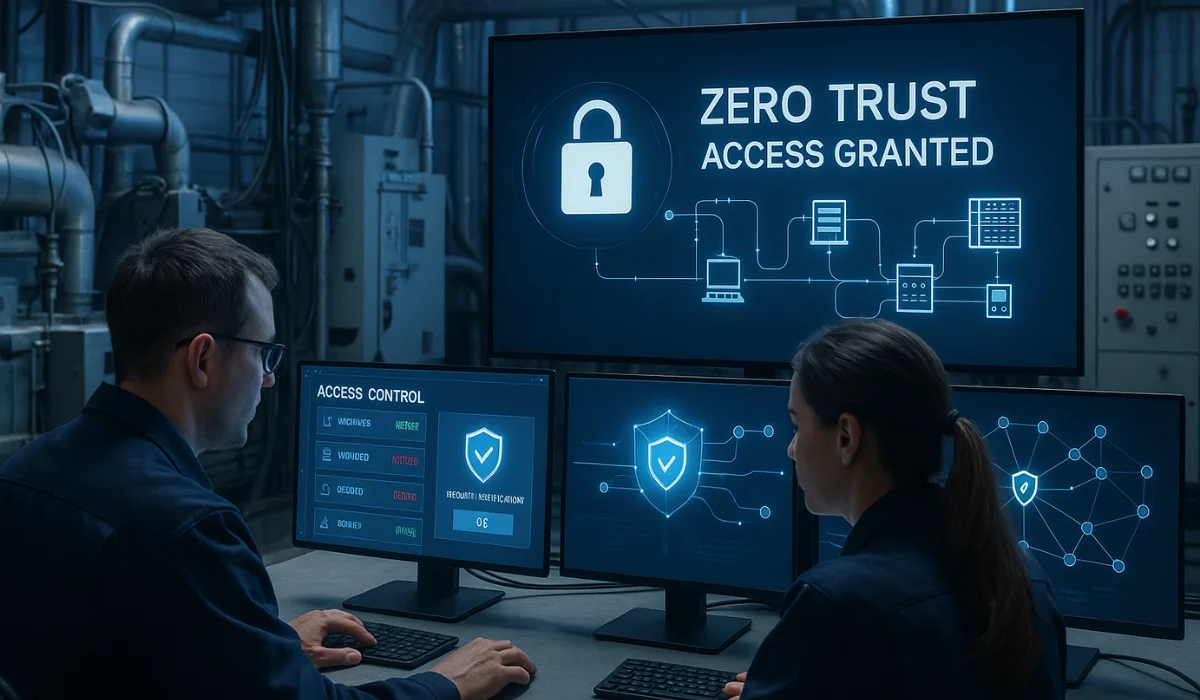
That’s why Zero-Trust Security is becoming essential for manufacturers. By verifying every user, device, and connection before access, you contain ransomware, protect uptime, and strengthen compliance: principles at the core of understanding Zero Trust Security.
The model is designed to scale in phases, allowing teams to secure systems without disrupting production. Many manufacturers use co-managed IT to support growth and security, combining internal oversight with expert monitoring to achieve this balance.
Frameworks such as NIST SP 800-207 and CISA Zero-Trust guidance outline how this verification-first approach maintains the resilience of operational technology, IoT devices, and industrial control systems, including factory networks.
Let’s look at why manufacturers need Zero-Trust now.
Key takeaways
- Deploy Zero-Trust controls to contain breaches faster by limiting lateral movement and reducing costly downtime.
- Align compliance efforts with frameworks such as NIST SP 800-207 and CISA Zero Trust guidance to meet audit and reporting requirements.
- Begin Zero-Trust adoption with identity and network segmentation to strengthen visibility and minimize disruption during rollout.
- Coordinate IT and OT security to close visibility gaps and ensure every connected device and user is continuously verified.
Understanding Zero-Trust security in manufacturing
Zero-Trust follows one core principle: never trust, always verify. Instead of assuming users or systems inside the network are safe, every access request must prove its legitimacy. In modern manufacturing environments, where operational technology connects with enterprise systems and the cloud, this model closes security gaps that traditional network perimeter defenses cannot cover.
A Zero-Trust architecture relies on identity and access management (IAM) and continuous authentication to confirm each user and device is legitimate. For example, a technician’s tablet must authenticate before adjusting a PLC or accessing production metrics.
Layered controls consider device health, user role, and activity patterns to provide a more comprehensive approach. Zero-Trust reduces dwell time and speeds up incident detection by containing breaches early.
Zero-Trust isn’t a product; it’s a framework for continuous verification, segmentation, and adaptive defense across operational technology environments, as outlined in NIST Special Publication 1800-35.
Most manufacturers begin with identity management and network segmentation to phase in controls without disrupting production.
Why manufacturers need Zero-Trust now
Ransomware and other cyber threats are no longer limited to office IT. The U.S. Office of the Director of National Intelligence reports a 15% year-over-year rise in global ransomware attacks.
Legacy authentication and flat networks leave OT environments vulnerable to exposure. Many factories still rely on implicit trust between systems, allowing attackers to move laterally once they breach a single point of entry.
Recognize industrial networks as prime ransomware targets
Attackers target manufacturers because aging industrial control systems (ICS) and unpatched equipment create easy entry points for malicious activity. Each attack risks downtime, safety issues, and revenue loss. A single data breach can spread quickly through interconnected systems and suppliers.
Control remote access and vendor connections
Remote support and vendor maintenance expand the attack surface. Traditional VPNs often grant broad access, which is usually unnecessary. Replacing them with Zero-Trust Network Access (ZTNA) gives external partners secure access only to specific assets and for limited time windows.
For example, a vendor can inspect one robot cell in the supply chain without visibility into other systems within the supply chain. These focused permissions protect uptime and safety while maintaining operational agility.
Meet tightening compliance requirements
Regulatory frameworks, such as the Cybersecurity Maturity Model Certification (CMMC) 2.0, ISO 27001, and NIST CSF 2.0, now emphasize the principle of least privilege, security controls, and the protection of critical infrastructure. Aligning your security model with Zero-Trust principles supports compliance audits and proves proactive risk management to customers and regulators.
Prevent costly downtime through proactive access control
Downtime is one of the most expensive outcomes of a breach. According to JumpCloud, unplanned outages cost an average of $14,000 per minute. Preventing production downtime with proactive IT support allows manufacturers to identify and isolate issues early through continuous verification.
This highlights the importance of proactive access control, automation, and segmentation in preventing lateral spread in real-time. Coordinating firewalls, ZTNA, and perimeter-based security improves containment and reduces mean time to recovery.
For manufacturers, Zero-Trust offers a practical way forward. By starting with identity controls and segmented networks, teams can protect uptime without disrupting production. These challenges set the stage for the practical controls that make Zero-Trust work.
Core principles of Zero-Trust security in manufacturing
Zero-Trust operates through a few essential principles that redefine how manufacturing systems stay secure and resilient.
Limit permissions with least privilege access
Every user and device receives only the access needed to perform specific tasks. Applying least privilege access limits the potential damage if credentials are compromised. On the shop floor, an operator can view data but cannot alter controller code.
Divide systems through micro-segmentation
Using micro-segmentation and network segmentation isolates production zones, engineering networks, and ERP systems. If malware reaches one area, it cannot spread laterally to other places. This containment strengthens your security posture and protects uptime.
Continuously verify users and devices with multi-factor authentication
Multi-factor authentication (MFA) adds an extra layer of security for every login or connection. Continuous checks ensure that even trusted users are verified throughout each session.
Maintain device integrity and patch endpoints
Regularly updating and validating each endpoint, from programmable logic controllers (PLCs) to mobile tablets, reduces risks and supports consistent system performance. Manufacturers should also implement centralized patch management to ensure that updates are applied quickly across all connected assets, thereby minimizing exposure to known vulnerabilities.
Monitor traffic in real time with automation and threat intelligence
Continuous monitoring detects anomalies as soon as they occur, a reminder that network monitoring is critical for manufacturing operations to identify and isolate threats in real time. Integrating automation and threat intelligence enables faster response and isolation of potential intrusions.
The NIST CSF 2.0 framework highlights growing adoption of these controls across the industry.
Together, these principles create a scalable security model that replaces implicit trust with verification, ensuring production runs securely.
Common roadblocks to implementation
Building a Zero-Trust foundation in manufacturing requires more than new tools. It demands coordinated modernization, cultural change, and incremental rollout.
Modernize legacy OT systems that lack authentication
Many legacy systems and older OT systems lack built-in authentication. Modernizing through IT modernization in manufacturing closes these gaps and enables secure integration of Zero-Trust gateways. Adding secure gateways introduces identity verification between aging controllers and the network, creating secure access without requiring the replacement of critical hardware.
Overcome internal resistance and training gaps
Employees may see new controls as obstacles to productivity. Regular awareness sessions and clear communication demonstrate how Zero-Trust safeguards uptime and safety without slowing work.
Integrate IT and OT without disrupting production
Successful integration starts small. Pilot Zero-Trust controls on one production line before scaling. This approach strikes a balance between security and operational continuity.
Shift culture toward shared security ownership
Strong security teams bridge IT and OT expertise to manage process shifts and sustain adoption. Many organizations achieve this with co-managed IT for manufacturing, which strengthens collaboration and keeps Zero Trust implementation on track. Collaboration ensures security decisions support both production and compliance goals.
Dragos’ data shows industrial ransomware often forces manual failovers and shutdowns, proving that delaying modernization increases risk.
A phased approach enables manufacturers to address these challenges step by step, while maintaining safety, uptime, and operational confidence.
A phased approach to Zero-Trust for manufacturers
Adopting Zero-Trust is most effective when implemented gradually. A phased rollout enables manufacturers to replace implicit trust with verified controls, while maintaining uptime and minimizing disruptions across complex IT and OT ecosystems.
Phase 1: Assess your IT/OT environment and map assets
Start by cataloging every user, device, and system connection. This audit reveals zones of implicit trust that could facilitate the spread of intrusions. Include connected devices, legacy controllers, and workloads in your review to identify potential vulnerabilities.
Phase 2: Implement identity and access management (IAM)
Implement multi-factor authentication (MFA) and establish clear, role-based permissions for users and machines. Strengthening identity verification ensures that only authorized entities can reach sensitive systems or data.
Phase 3: Segment networks by function and criticality
Apply network segmentation to isolate production, engineering, and corporate environments. When segments are separate, attacks cannot easily move laterally, which reduces operational risk and strengthens resilience.
Phase 4: Deploy continuous monitoring and response tools
Integrate automation and continuous monitoring to detect and respond to threats in real-time. Automated workflows analyze activity across both your data center and factory floor, ensuring faster containment when anomalies appear.
Phase 5: Review and refine controls regularly
Use dashboards that show metrics such as access requests, failed logins, and policy violations. These insights help refine security policies every quarter and align ongoing initiatives with the Zero-Trust lifecycle.
CISA treats Zero-Trust as a benchmark for government and critical sectors, indicating that manufacturers should adopt similar expectations.
How Keystone helps manufacturers adopt Zero-Trust security
Keystone’s Zero-Trust framework strengthens cybersecurity without interrupting production. Our team combines expertise in both IT and OT networks, enabling manufacturers to secure their digital and physical assets under a single, unified strategy.
We start by assessing maturity levels and identifying compliance gaps. Next, we design a custom roadmap that prioritizes secure access, threat detection, and seamless integration across your critical infrastructure.
Our security approach focuses on practical steps that reduce complexity while maintaining operational flow. We guide your team through setup, testing, and training to ensure sustainable adoption.
Keystone also provides continuous monitoring, incident reporting, and regular reviews to confirm steady progress toward full Zero-Trust maturity.
Partnering with Keystone helps your organization advance its Zero-Trust framework, enhance visibility across systems, and protect against modern industrial threats, key aspects of building cyber resilience in manufacturing.
Final thoughts: Zero-Trust = continuous resilience
In modern connected factories, Zero-Trust Security in Manufacturing is more than a cybersecurity framework. It represents a shift toward continuous resilience, where every access request, device, and process is verified before it can affect production. This zero-trust approach minimizes risk, strengthens visibility, and builds a foundation that keeps operations secure from the inside out.
By protecting your intellectual property and sensitive data, Zero-Trust supports digital transformation while maintaining integrity across your IT environments. The payoff is clear: fewer disruptions, stronger compliance, and a system designed to adapt as threats evolve.
True resilience is not achieved once; it requires ongoing commitment to monitoring, testing, and improvement.
Take the next step toward continuous resilience with Keystone’s Zero-Trust framework.
Schedule a consultation today to see how it reduces response time, maintains near-constant uptime, and safeguards IP.
FAQs
How does Zero-Trust Security in Manufacturing protect against ransomware attacks?
It reduces ransomware risk by verifying every user, device, and connection before access. This approach complements firewalls and endpoint tools, blocking the sideways movement of malware, allowing manufacturers to stop attacks faster and recover with less downtime.
What’s the first step to implementing a Zero-Trust framework in manufacturing environments?
Begin with a comprehensive audit of users, devices, and data flows to identify areas where implicit trust remains. That visibility guides Zero-Trust implementation, helping teams apply access controls and monitoring where they’re most needed while keeping production on schedule.
How can manufacturers maintain uptime while adopting Zero-Trust security controls?
Roll out Zero-Trust in stages. Start with network segmentation and role-based permissions, then add automation and real-time monitoring. This phased approach protects industrial networks and maintains steady uptime while security improves.