In manufacturing, every second of downtime hits your bottom line. To stay competitive, you need streamlined operations, reliable systems, and technology that just works.
The challenge? Lean manufacturing demands more from your IT than ever before. From cybersecurity and compliance to automation and scheduling, the technology that keeps your plant running is only as strong as the team managing it. For many manufacturers, internal IT teams are already stretched thin, struggling to meet basic day-to-day needs, let alone larger initiatives such as digital transformation.
That gap has real consequences. 86% of manufacturing executives believe that smart-factory solutions will be the top driver of competitiveness within the next five years. However, without proper IT management in place, those solutions remain on the shelf.
This is where co-managed IT services come in. Working with a managed IT service provider means you can fill skill gaps, gain specialized expertise, and strengthen your IT operations without increasing your internal headcount. You get the benefits of co-managed IT, including 24/7 support, cybersecurity resilience, and a partner who can help you streamline your systems to better align with your business needs.
Key takeaways
- Don’t wait for a system failure to modernize. Downtime costs manufacturers over $125,000 per hour. Most of it stems from preventable IT bottlenecks. If your team is stuck in support mode, you’re losing ground.
- Smart-factory investments are accelerating, but many manufacturers still struggle to realize their full value. Co-managed IT ensures that new technologies are not only installed but also effectively utilized. They are integrated and aligned with your production goals.
- Hiring full-time staff for every IT need isn’t efficient. A co-managed model provides 24/7 access to cybersecurity, automation, and infrastructure expertise without requiring additional payroll costs.
- Lean manufacturing isn’t just about the shop floor. IT must also run lean. Streamlined systems reduce waste, avoid downtime, and drive productivity across every shift.
- If your team is stuck firefighting, you’re not scaling. You’re stalling. Offload the routine. Free up your experts to focus on innovation.
What makes manufacturing IT so challenging?
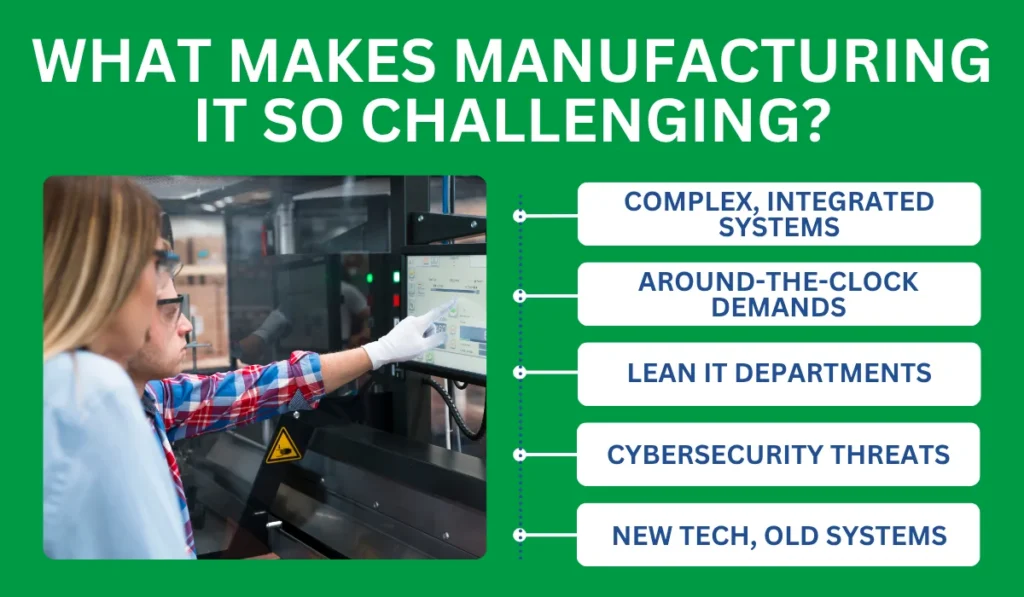
Manufacturing businesses operate in a unique environment where operational technology (OT) and complex IT systems intersect. From enterprise resource planning (ERP) platforms to IoT sensors and legacy control systems, your technology stack is deeply intertwined with your physical operations. Maintaining uptime is essential.
Complex, integrated systems
Modern manufacturing relies on an intricate blend of systems, including MES (Manufacturing Execution Systems), ERP, supervisory control and data acquisition (SCADA) systems, IoT devices, and legacy machinery that often run outdated software. Keeping these platforms in sync takes deep expertise in both OT and IT.
Around-the-clock demands
Manufacturers often run on 24/7 schedules. There’s no “off” button to troubleshoot problems during the night or over the weekend. If something breaks, every minute of downtime has a price tag. Downtime can cost up to $260,000 per hour, a figure that has increased by more than 50% since 2020.
Lean IT departments
Most small and mid-sized manufacturers have lean internal IT teams focused on day-to-day issues, help desk support, and hardware troubleshooting. They often lack the necessary bandwidth to undertake digital transformation projects, cybersecurity initiatives, or large-scale upgrades.
Cybersecurity threats
Industrial environments are prime targets for cyberattacks, particularly ransomware. IBM’s 2024 report found that the industrial sector experienced the most significant increase in breach costs, with incidents averaging over $4.7 million, a 21% increase from the prior year.
New tech, old systems
Emerging tools, such as cloud services, automation platforms, and advanced analytics, offer significant efficiency gains. However, many manufacturers struggle to integrate them with existing systems, often delaying upgrades due to concerns about downtime, high costs, or skill gaps.
When working with tight margins and complex operations, any IT issue can put your business at risk.
How co-managed IT supports lean manufacturing goals
Co-managed IT blends your in-house team’s knowledge with outside experts to scale your IT without hiring more staff. This isn’t outsourcing; it’s strategic support.
Fills skill and resource gaps without increasing headcount
Lean doesn’t mean lacking resources. A co-managed approach provides access to highly specialized IT professionals without the expense of hiring full-time staff. Whether you need help with patching, cloud solutions, or network security, you can tap into that expertise as required.
For example, while your in-house IT team handles onsite troubleshooting and end-user support, your co-managed partner can assist with automation rollouts, server upgrades, or complex ERP integrations.
Provides 24/7 monitoring and rapid response
You can’t afford delays. With real-time monitoring and alerting, this service model helps detect and resolve issues before they cause downtime. Many providers offer service-level agreements (SLAs) that guarantee response times and resolution windows.
This always-on model helps manufacturers maintain uptime across production shifts, without requiring overnight or weekend staffing.
Supports the integration of new technologies
Manufacturers that invest in automation and digital tools experience measurable efficiency improvements. 69% of companies plan to increase their investments in smart factories over the next year.
Co-managed partners bring the expertise to help implement these tools, whether that’s migrating to Azure, modernizing your ERP, or adding new production analytics. They also ensure that new tools don’t introduce vulnerabilities or bottlenecks.
Improves cybersecurity posture
With cyber threats evolving faster than most internal IT teams can keep up, manufacturers need a dedicated security strategy. A co-managed IT model offers advanced threat detection, vulnerability scanning, endpoint protection, and disaster recovery planning.
And because manufacturing businesses deal with both data and physical output, a single breach can halt operations. Co-managed partners can also assist in navigating compliance with the National Institute of Standards and Technology (NIST) and the Cybersecurity Maturity Model Certification (CMMC), as well as other industry-specific requirements.
Delivers proactive maintenance
Lean operations rely on a stable and secure infrastructure. Proactive maintenance involves identifying and resolving potential issues before they lead to downtime. Co-managed IT services handle this through scheduled patching, hardware monitoring, cloud backup testing, and system health checks.
This shift from reactive to proactive IT reduces disruptions and extends the life of your systems.
Frees up internal teams to focus on innovation
Your internal IT department is familiar with your plant, personnel, and processes. But they’re often bogged down with help desk tickets and break/fix tasks. A co-managed model allows them to offload those tasks and focus on strategic initiatives, such as digital workflows or more innovative scheduling tools.
When your team isn’t fighting fires, they can pursue improvements that drive competitive advantage.
Comparison: In-house only vs. co-managed IT
| Capability | In-House Only IT | Co-Managed IT Model |
|---|---|---|
| 24/7 Monitoring | Rarely feasible | Included with SLAs |
| Cybersecurity Expertise | Limited to generalist knowledge | Dedicated specialists + threat detection |
| Support for New Tech | Often delayed due to capacity | Accelerated with experienced IT consultants |
| Proactive Maintenance | The reactive approach dominates | Regular patching, updates, and health checks |
| Cost Efficiency | Higher per-capita labor costs | Scalable, cost-effective support as needed |
| Focus on Innovation | Limited due to support workload | Freed up the internal team for high-value projects |
The cost of not leveraging co-managed IT
Imagine this: Your internal IT staff is stretched to the limit. You delay upgrading an outdated server running your ERP system. A failure occurs during the second shift, and production halts for 12 hours.
You lose a day’s output, scramble to recover data, and pay overtime to catch up. And your customers start to question your reliability. That one issue now costs you tens of thousands in lost revenue, not to mention brand damage.
This is not uncommon. A recent Institute for Supply Management (ISM) report revealed that two-thirds of companies experienced unplanned downtime at least once a month, at $125,000 per hour.
The risk compounds when security gaps are ignored. Outdated antivirus software or missed patches create easy openings for cyberattacks. And if ransomware infects a connected OT system, it doesn’t just steal data; it also renders machines inoperable.
What to look for in a co-managed IT partner for manufacturing
Not every MSP is equipped to support manufacturing environments. You need a partner who understands the nuance of IT and OT working together. Here’s what to prioritize:
Experience with manufacturing systems
Look for a provider with hands-on experience supporting ERP, MES, SCADA, and IoT environments. Ask about their familiarity with your industry’s regulatory requirements and production tools.
Flexible, collaborative support
The right partner will treat your internal IT team like collaborators, not clients. Select a provider that offers comprehensive support options, ranging from full-stack infrastructure management to supplemental cybersecurity services.
Demonstrated track record
Ask for client case studies or performance metrics. Have they improved uptime, streamlined onboarding, or reduced patching cycles for similar manufacturers?
Local presence and responsiveness
Manufacturing doesn’t slow down, and neither should your IT partner. Local teams can provide faster onsite support and understand regional labor laws, facility compliance, and connectivity limitations.
Why manufacturers choose Keystone Technology Consultants
If you’re serious about reducing downtime, optimizing performance, and aligning your technology with your business goals, Keystone Technology Consultants is built for you. For over 25 years, we’ve helped manufacturing leaders address growing IT needs without increasing their internal IT resources.
We understand what it takes to modernize complex environments while supporting day-to-day operations. We purpose-build our co-managed IT services to help your internal team, strengthen your IT management strategy, and streamline every layer of your infrastructure.
Keystone offers:
- Dedicated support teams for ERP, network security, and automation
- 24/7 monitoring and help desk services with guaranteed response times
- Integration support for Azure, Microsoft 365, and hybrid-cloud systems
- Real-world experience with OT/IT convergence and production-critical infrastructure
If you’re ready to assess how your IT operations measure up and identify areas for improvement, I invite you to take the next step.
Get your free IT efficiency assessment todayFAQ section
What is co-managed IT?
Co-managed IT is a partnership between your internal IT team and a managed service provider. Instead of replacing your staff, the MSP supports them by handling tasks like monitoring, maintenance, and cybersecurity. It strengthens your IT operations without adding headcount.
Does it replace your internal team?
No. Co-managed IT enhances your team’s capabilities by filling gaps and offloading routine tasks. Your staff retains control and knowledge, while the MSP adds expertise and scalability to keep your systems running smoothly.
How does it reduce downtime?
With 24/7 monitoring, proactive maintenance, and fast response times, co-managed IT helps catch issues early and recover quickly from outages. This minimizes disruptions and protects production schedules.